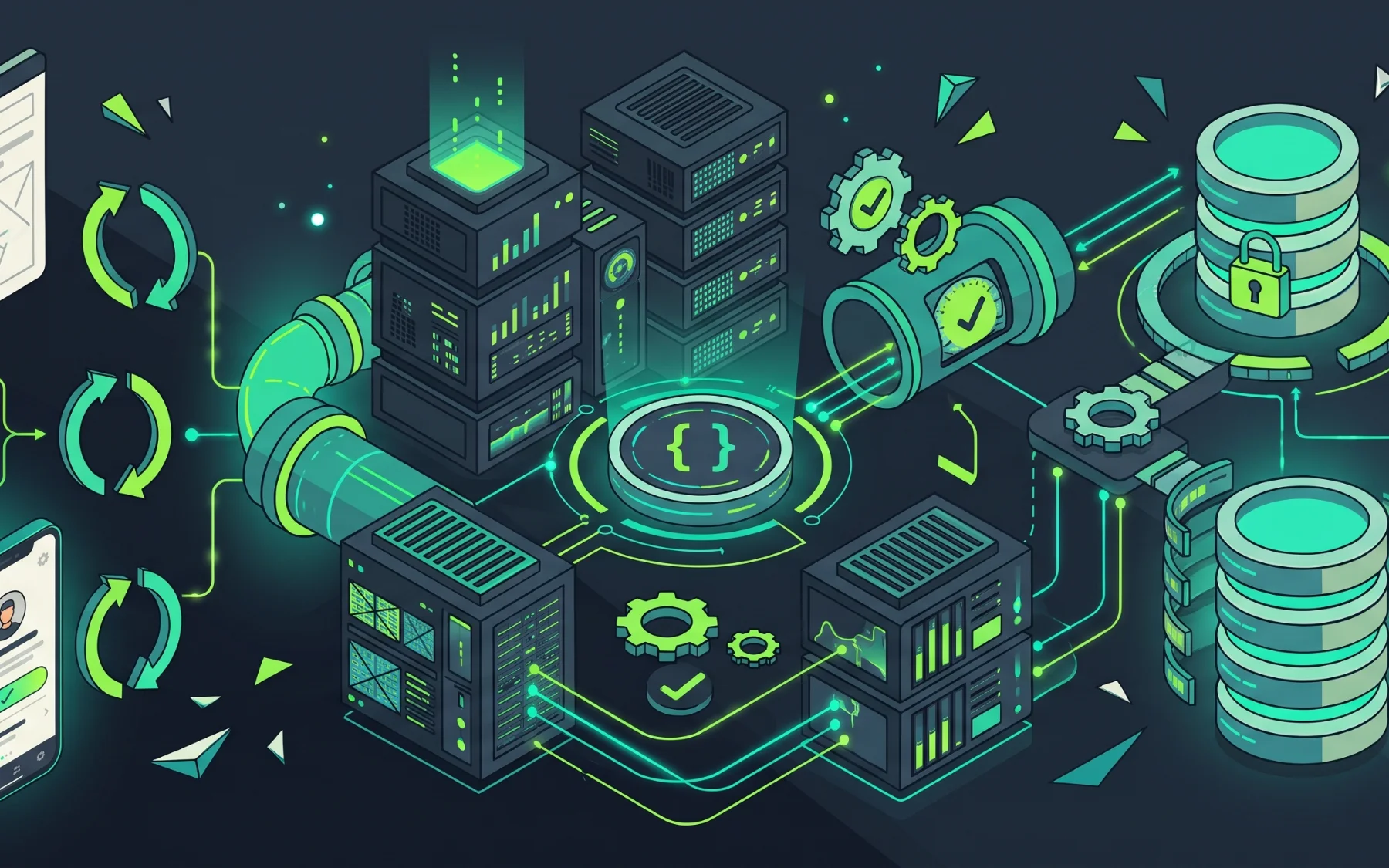
We build the APIs, databases and cloud infrastructure behind your product, with monitoring and alerts from day one. Every service ships with documentation and a runbook, so your team knows what to do when something breaks.
What you get
Agreed in writing before we start, so you know exactly what you’re paying for.
REST or GraphQL APIs with versioned, documented endpoints
PostgreSQL schemas and migrations your team can reason about
Cloud infrastructure on AWS or GCP, defined as code
Monitoring, alerts and a runbook for each service
Who this is for
- Products outgrowing their first backend
- Teams integrating payments, logistics or health data
- Companies that need an API other developers can rely on
How it works
What happens, in order, once we start. You see working software every two weeks, not just a report.
Map the data and the systems
We find out which system is the source of truth for what, how the outside services you depend on behave, and where requests can fail.
Agree the contract first
The API is written up as an OpenAPI or GraphQL schema and reviewed with the people who’ll use it, before the code behind it exists.
Build, test and automate
Tests on every endpoint, retries that are safe to repeat, and infrastructure defined as code, deployed through a pipeline rather than by hand.
Run it and hand it over
Monitoring, alerts and a runbook for each service go live with the first release, so your team knows what to do when something breaks.
Technologies we use
How we’d approach it
Illustrative examples of how we think, not client projects.
Illustrative example
Example: healthcare booking
How we’d design a booking flow patients finish
An illustrative example: show open times first, and ask for details only after a slot is held.
Illustrative example
Example: fintech project rescue
How we’d rescue an API weeks before launch
An illustrative example: secure it, test the paths that move money, and cut scope until the date is realistic.
Common questions
Only when there’s a clear reason, like separate teams or very different scaling needs. A well-structured single service is cheaper to run and easier to understand.
Yes. We profile the slow endpoints, fix the database queries and caching first, and show you the before and after numbers.
Yes: payment, accounting, shipping, CRM and similar. We plan for the parts that usually break, like timeouts, rate limits and data that means different things in each system, and log every request so you can see what happened.
REST for most public and partner APIs, because it’s simpler to cache, secure and document. GraphQL when several front ends need very different slices of the same data.
Read before you start
Practical guides from our blog for anyone planning APIs & backend work.
- API integrations: what goes wrong, and how to plan for itConnecting two systems looks simple in the documentation. Here's what actually breaks in business automation and API work, and how to design for it.
- Build or buy: when custom software is worth itMost businesses should buy most of their software. Here's a practical way to spot the part you should build, written by people who sell the building.
- Rewrites are usually a trapYour old codebase is ugly. That doesn't mean starting over will fix it. Here's how to decide, and what to do instead.
Talk to us about APIs & backend
We reply within two working days. If we’re not the right fit, we’ll say so and point you to someone who is.
- You send a few lines. No brief or slide deck needed.
- We reply with questions or an honest “not for us”.
- We scope it together. You get a fixed plan and a fixed price for the first release, before any development starts.
- Projects from$15k
- Typical first release8–12 weeks
- Emailhello@hellnah.dev
- Phone+977 9713639802