September 3, 2026, updated November 4, 2026. 3 min read. By Hell Nah team.
Every client wants to know three things before they sign: what it'll cost, when it'll be done, and what they'll get. Every honest studio knows you can only promise two of those at once.
The trouble is that a lot of quotes promise all three anyway. Something still gives way, and it's usually quality, which you find out about in production.
The rule we work to
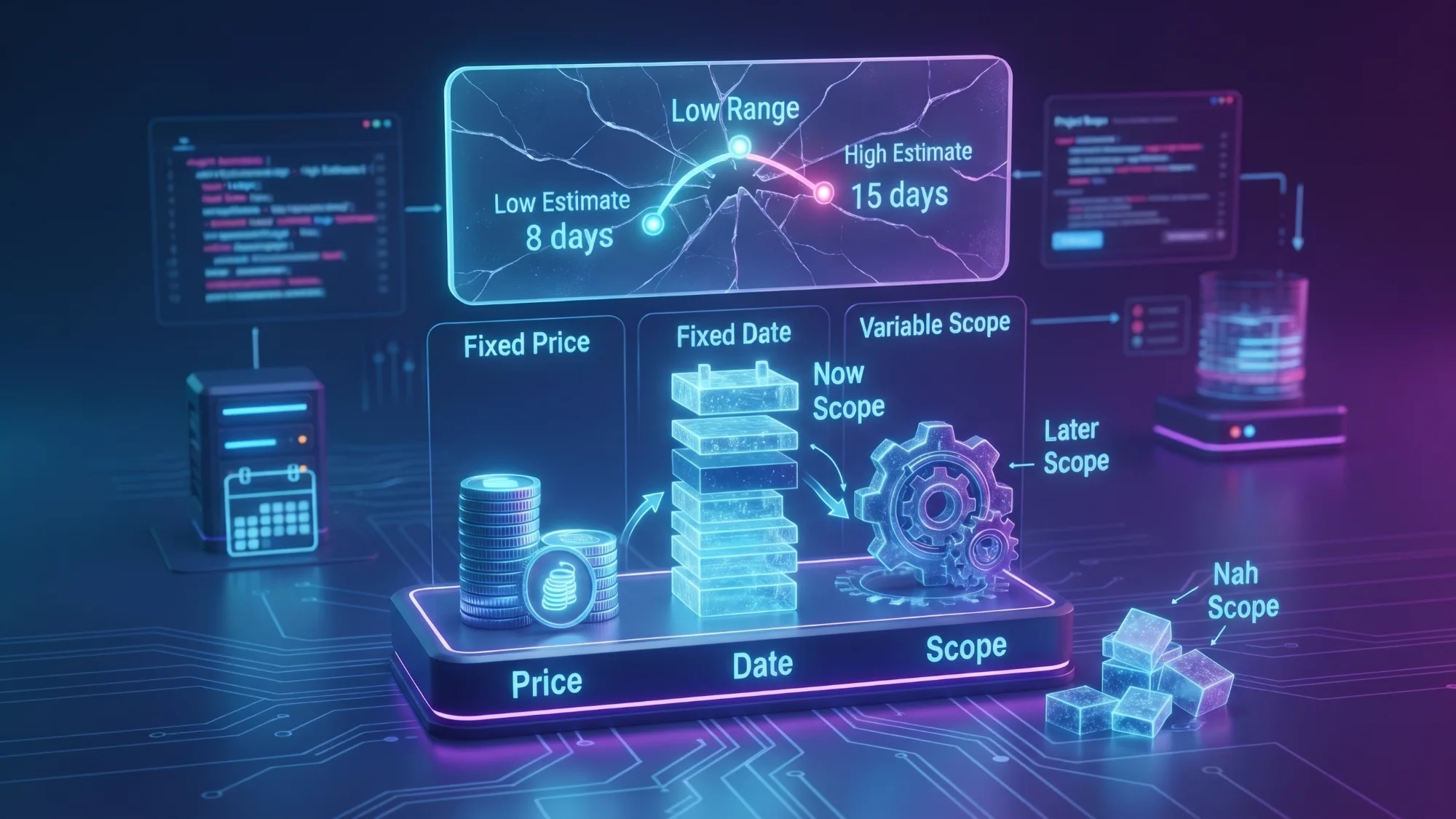
We fix the price and the date for each release. Scope is what moves.
That sounds risky for the client until you look at the alternatives:
| What's fixed | What gives way | What it feels like |
|---|---|---|
| Scope and date | Quality | On time, then months of bugs |
| Scope and price | The date | "Two more weeks", repeatedly |
| Price and date | Scope | You choose what ships first |
Only the last one puts the decision in your hands. You always know what you're spending and when you'll have something, and you decide what matters most.
How it works in practice
- Spend the first two weeks listing everything you want, and sort it into now, later and nah.
- Estimate the now pile in ranges, not single numbers.
- Commit to the bottom of the range, and treat everything above it as a bonus.
- Every two weeks, look at what's done and swap items in and out of the now pile.
Here's an example. These numbers are invented to show the method:
| Feature | Low estimate | High estimate |
|---|---|---|
| Sign-in and accounts | 3 days | 5 days |
| Booking flow | 8 days | 15 days |
| Payments | 5 days | 12 days |
| Admin screens | 4 days | 10 days |
| Total | 20 days | 42 days |
The gap between 20 and 42 is information. The booking flow and payments are where the uncertainty sits, so that's where you'd spend the first week reducing it, before anyone commits to the rest.
Why ranges matter
A single-number estimate is a guess dressed up as a promise. A range tells you how confident someone is. A wide range means they don't know enough yet, and that's a useful thing to learn before you've paid for it.
If an estimate ever looks too good to be true, ask for the range. If they can't give you one, that's your answer.
How to read an estimate you've been given
Whoever you hire, these questions will tell you a lot:
- What's not included? A good estimate lists exclusions. Testing, deployment, and app store review are the usual quiet omissions.
- What are you least sure about? Anyone who says "nothing" hasn't looked hard enough.
- What happens when you're wrong? You want a specific answer about scope and money, not reassurance.
- Who is doing the work? An estimate from a senior team means little if juniors you've never met do the build.
Common questions
Should I always pick the cheapest of three quotes?
No. A low quote usually means less is included, or someone is less sure of the risk. Compare what's excluded before you compare the totals. Our guide to what custom software costs goes through what drives the number.
Can you give me a fixed price from a one-page brief?
You can get a range, but not a promise. A price you can rely on comes after someone has looked at the risky parts, which is why we do two weeks of discovery and scoping first.
What if priorities change halfway through?
They will. That's what the two-week cycles are for. Swap something in, and something of a similar size comes out, while the date and price stay put.
Working on something like this?
Tell us what you’re building. We reply within two working days, and if we’re not the right fit, we’ll say so.
Related service: Custom web application development